Free guide · 32 pages
Scaling AI adoption in marketing.
A tactical guide for leaders.
How B2B marketing teams move from scattered pilots to repeatable, measurable results.
Get the guide.
Free. Instant download.
We’ll only use your details to send the guide and the occasional note from Tofu. Privacy policy.
Start here
Everyone’s using AI. Almost nobody can prove it’s working.
More usage. Less proof. The bar moved from hours saved to pipeline, and most teams are still clearing the old bar.
-
Marketers using AI
63%91%
In one year. Jasper, 2026
-
Marketers who can prove ROI
49%41%
Over the same year. Jasper, 2026
-
Marketing teams actually scaling AI
14%
46% are still piloting. Marketing AI Institute, 2025
-
Revenue growth of “future-built” companies vs. laggards
2.4x
BCG, 2026
The (un)sexy truth
It’s not a tooling problem. It’s an operating model problem.
The winners didn’t find a magic tool. They changed how their teams work. The guide shows you how to do the 70%.
- 10%Algorithms
- 20%Technology and data
- 70%People and process
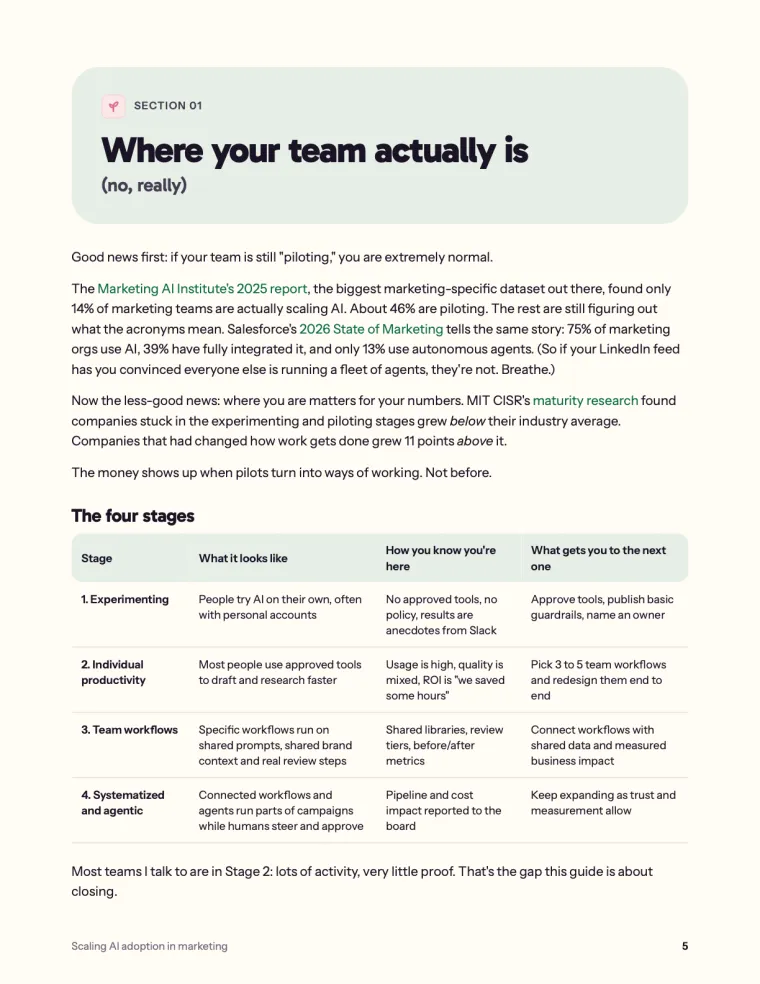
The four stages
Where your team actually is.
Good news first: if your team is still piloting, you are extremely normal. The money shows up when pilots turn into ways of working.
-
1
Experimenting
People try AI on their own, often with personal accounts.
Results are anecdotes from Slack.
-
2
Most teams are here
Individual productivity
Most people use approved tools to draft and research faster.
ROI is “we saved some hours.”
-
3
Team workflows
Workflows run on shared prompts, shared brand context and real review steps.
Before and after metrics.
-
4
Systematized and agentic
Agents run parts of campaigns while humans steer and approve.
Pipeline impact reported to the board.
Not sure where you are? The guide opens with a 2-minute self-assessment.
What’s inside
Ten sections. Each one ends with a to-do list.
“Do this next” items you can assign on Monday. Every stat links to its source, so you can take it straight to your CFO.
- 01
Where your team actually is (no, really)
The four stages of AI maturity and a 2-minute self-assessment.
- 02
Why adoption stalls (it’s not the robots)
Missing training, legal bottlenecks, messy data, shadow AI and pilots with no end date.
- 03
Pick the right use cases (not all 47 of them)
Score ideas on value, feasibility and risk, then steal seven proven plays.
- 04
Build the foundation (the boring part that makes everything work)
One brand context layer, clean data, a sane stack and review rules legal can live with.
- 05
Who owns AI, and who does what now
Owners, a small council, the new builder roles and the five training hours that matter.
- 06
Why your team is secretly using ChatGPT
Stigma, anxiety, workslop and trust, and why managers are your biggest lever.
- 07
Measure what matters (hint: not just hours saved)
A four-rung metrics ladder that climbs from adoption to pipeline.
- 08
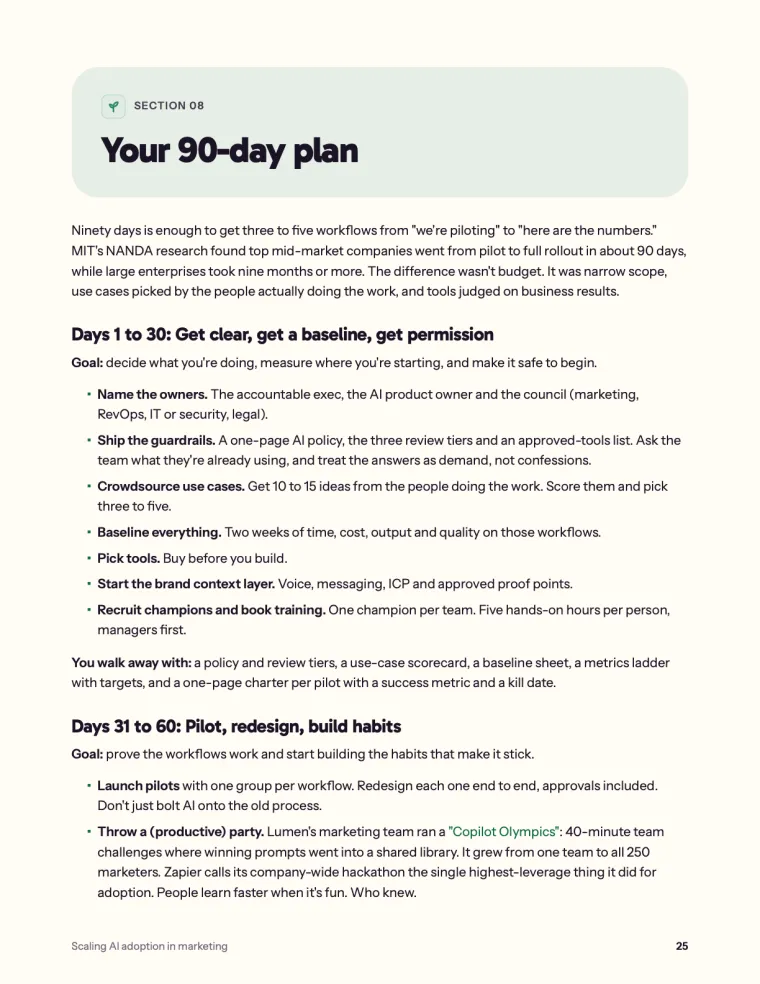
Your 90-day plan
Days 1 to 30, 31 to 60 and 61 to 90, from “we’re piloting” to “here are the numbers.”
- 09
Your buyers are using AI too
Half of software buyers now start in a chatbot. How to show up in the answer.
- 10
Toolkit
A maturity self-assessment, an AI policy starter, vendor questions and a use-case worksheet.

Go from pilots to proof.
Thirty-two pages for marketing leaders who need AI to show up in pipeline, not just in hours saved.